Quick answer: There's no form to submit and no fixed list to climb, and OpenAI says placement in ChatGPT search isn't guaranteed. To make it more likely ChatGPT names your business: allow OpenAI's search crawler, OAI-SearchBot, in your robots.txt and firewall; make sure your pages are indexed in Bing and Google; keep your name, address, phone, hours and services identical everywhere; publish pages that answer customer questions in the first sentence; earn reviews and mentions on the sites ChatGPT cites; and re-test the same questions every month.
When someone asks ChatGPT "Who's a good family dentist in [city]?" or "Which plumber near me does same-day water heater repair?", it doesn't show ten blue links. It writes a short answer that names a few businesses and links the pages it used. "Ranking in ChatGPT" means being one of those names, and ideally one of those linked pages.
This guide sticks to what OpenAI, Microsoft Bing and Google have published about how their AI answers find content, then turns that into steps a dental practice or home-service company can work through.
How ChatGPT finds local businesses
No AI company publishes a ranking formula. What OpenAI does publish is how ChatGPT search gets its information:
| What OpenAI says | What it means for you |
|---|---|
| OAI-SearchBot is the crawler that surfaces websites in ChatGPT's search features. Sites that opt out of it won't be shown in ChatGPT search answers (OpenAI crawlers). | If your robots.txt or firewall blocks OAI-SearchBot, your site can't be a cited source. |
| ChatGPT search sometimes partners with third-party search providers, and it usually rewrites a question into shorter, targeted queries before sending them (OpenAI Help Center). The privacy statements OpenAI points to include Microsoft's. | Ranking in regular search for short phrases like "emergency plumber [city]" still matters, and Bing is worth checking, not just Google. |
| ChatGPT may use an approximate location from the user's IP address and rewrite "near me" into a city search. | Your city, neighborhoods and service area need to be stated plainly on your pages and listings. |
| GPTBot crawls for model training. It is controlled separately from OAI-SearchBot. | Blocking training doesn't block search visibility. It's a separate business decision. |
Two practical points follow. ChatGPT's answers vary from one run to the next, so one screenshot tells you very little. And because it searches the web, the basics of SEO still decide whether you're in the pool of businesses it can choose from.
Step 1: Check what ChatGPT says about you today
Before you change anything, record a baseline:
- Write down 10 to 20 questions customers actually ask, with your city in them. For a dentist: "best dentist for implants in [city]", "dentist open Saturday [city]". For HVAC or plumbing: "AC repair same day [city]", "who fixes tankless water heaters in [city]".
- Open a temporary chat so memory doesn't shape the answer, and make sure search is on.
- Ask each question word for word. Note every business named, in order, and every page cited.
- Repeat on two more days. Count how many runs name you, for example "named in 1 of 3".
- Ask about your business by name: "What are the hours and address of [Business name]?" This is where wrong or outdated facts show up.
The cited pages are your to-do list. They show which directories, review sites and articles ChatGPT trusts for your trade and city.
Step 2: Let OpenAI's search crawler in
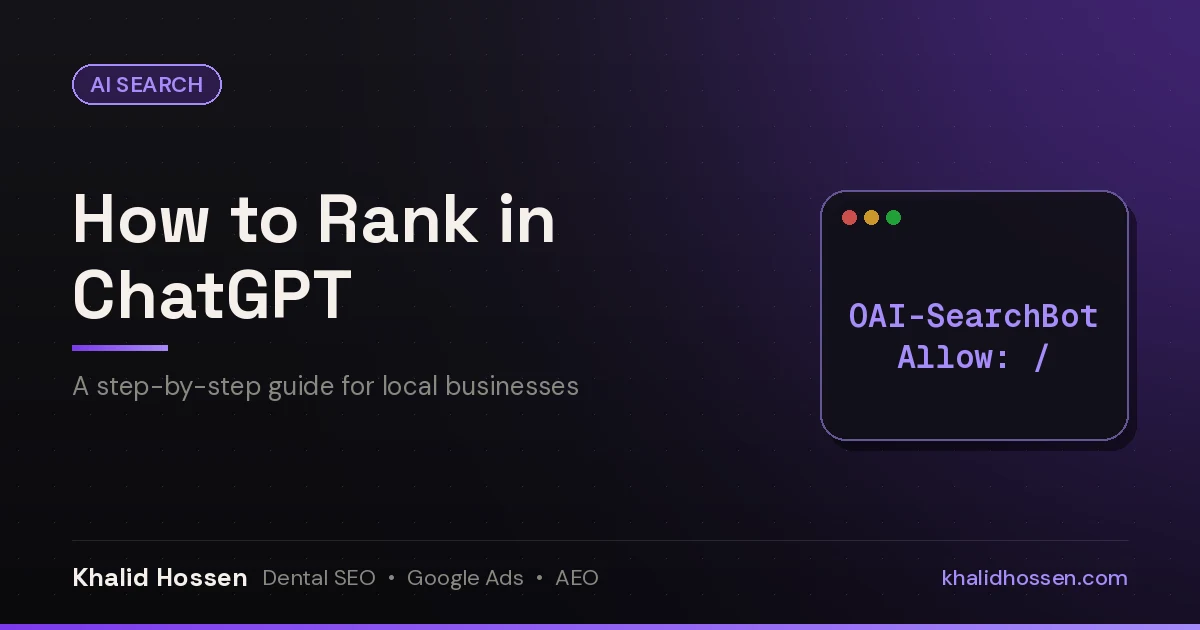
Open yourdomain.com/robots.txt and look for any rule that blocks OAI-SearchBot. To allow it explicitly, add:
User-agent: OAI-SearchBot
Allow: /
Then check the layer people forget. Security plugins, hosting firewalls and CDN bot settings can block crawlers that robots.txt allows. OpenAI recommends allowing requests from its published IP ranges (listed at openai.com/searchbot.json), and says search systems can take about 24 hours to adjust after a robots.txt change.
You may also see ChatGPT-User in your logs. That agent opens pages when a person asks ChatGPT to, and OpenAI says it isn't used to decide what appears in search. OAI-SearchBot is the one that matters for search visibility.
Step 3: Get indexed in Bing as well as Google
Bing is easy to overlook. Bing's guidelines cover its own search, Microsoft Copilot and its grounding results, and they ask for the same fundamentals as Google (Bing Webmaster Guidelines):
- Verify your site in Bing Webmaster Tools and submit your XML sitemap.
- Use IndexNow, or a plugin that supports it, so Bing hears about new and updated pages quickly.
- Keep important text in the HTML, not hidden behind scripts that need to run first.
- Avoid NOARCHIVE and NOCACHE on pages you want cited. Bing says NOARCHIVE keeps content out of Copilot answers, and NOCACHE limits Copilot to your URL, title and snippet.
Claim your Bing Places listing while you're there. It's one more source that should carry the same facts as your Google Business Profile.
Step 4: Make your business facts match everywhere
AI tools pull facts from many sources and compare them. If your website says one phone number, Yelp says another and an old directory lists a previous address, an AI tool may hedge or name someone else. Make these identical across your website, Google Business Profile, Bing Places, Apple Business Connect, Yelp and your industry directories:
- Business name, written the same way
- Address, or service area for businesses that go to the customer
- Phone number and website URL
- Hours, including weekend or emergency hours
- Services, using the words customers use ("dental implants", "furnace repair", "drain cleaning")
Add LocalBusiness structured data, or the closest type such as Dentist, Plumber or HVACBusiness, that matches the visible facts on the page. Bing says structured data may support clearer grounding but doesn't guarantee visibility, and that markup must reflect visible content.
Step 5: Write pages that answer one question each
Bing's guidelines spell out what makes a page easy to cite: put key information near the top, keep each URL focused on one topic, make facts explicit and make each page understandable on its own. For a local business, that usually means:
- One page per main service, with the service and city in the title and H1.
- A first sentence that answers the question. "We place and restore dental implants at our [City] office" beats three paragraphs about your philosophy.
- The facts people ask about: service area, hours, what you do and don't do, insurance or financing options you accept, and how to book.
- Short FAQs written in customers' words, with FAQ markup that matches the text word for word.
You don't need special files. Google says there are no AI text files, extra markup or special schema needed to appear in AI Overviews or AI Mode (Google Search Central), and OpenAI's crawler guidance asks for crawler access, not an llms.txt file.
Step 6: Earn reviews and mentions on the sites ChatGPT cites
Go back to the cited pages from your baseline and sort them:
| Cited source | What to do |
|---|---|
| Google Maps or your Business Profile | Complete every field and keep reviews coming in steadily |
| Review sites and directories for your trade | Claim the listing and make it match your website |
| "Best of" lists and local roundups | Ask the publisher how they choose businesses before you pay for anything |
| Local news, associations, chambers | Sponsor, speak, or offer expert comments where it's genuine |
| A competitor's own website | Read it and note which facts it states that your page doesn't |
Reviews are a big part of this, and they have to be collected the right way. See how to get more Google reviews for a step-by-step process that stays inside Google's and the FTC's rules.
Step 7: Re-test every month
Run the same questions, the same way, the same number of times each month. Track two numbers: how often you're named, and how often one of your pages is cited. Fix wrong facts as soon as you find them, at the source the AI cited. Movement usually takes months, not days, and it depends on how often crawlers revisit your site and how competitive your area is.
What not to do
- Don't hide text or instructions for AI. Bing lists prompt injection, cloaking and keyword stuffing as practices that can reduce visibility or get a site removed.
- Don't publish thin, mass-produced pages for every town in your county. Bing calls out automatically generated content at scale.
- Don't buy fake reviews or listicle spots that misrepresent your business.
- Don't trust ranking guarantees. Bing says generative engine optimization "does not guarantee grounding or citations", and OpenAI says placement isn't guaranteed. Nobody can promise you a spot in ChatGPT.
Ranking in other AI answers
The same work carries over. Google's AI Overviews and AI Mode use pages that are indexed and eligible to show a snippet in regular Google Search, with no extra technical requirements, and Google lists keeping your Business Profile up to date among its best practices. Bing says Copilot relies on the same crawling, indexing and ranking foundation as Bing search. If you've done the seven steps above, you've covered the foundations for most AI assistants.
Want help with it?
You can do every step in this guide yourself. If you'd rather have it done for you, my AEO and GEO services cover crawler access, entity cleanup, answer-ready pages, mentions and monthly tracking for dental practices and home-service companies.
To see where you stand first, get a free AI Search + Google Ads Visibility Audit: what AI answers (ChatGPT, Gemini, AI Overviews) say about your practice or business, your Google Maps ranking and Business Profile, how well your website converts, an optional Google Ads check, and a lead-response check of after-hours calls, missed-call text-back and form response time. No pitch, just facts. You'll get your audit within 3 business days.
Get a free audit · Book a 30-minute strategy call
Related guides
- How to get more Google reviews
- The latest SEO trends and updates
- Google Business Profile optimization for local SEO
FAQ
Can I pay to rank in ChatGPT?
Not in its search answers. OpenAI says ChatGPT ranks search results using multiple factors meant to surface relevant, reliable information, and that placement isn't guaranteed. Ads on ChatGPT are a separate product from being named in an answer.
Does ChatGPT use Bing for search?
OpenAI says ChatGPT search sometimes partners with third-party search providers and sends them rewritten queries, and the privacy statements it points to include Microsoft's. It also uses its own crawler, OAI-SearchBot. Being indexed in Bing and Google, and allowing OAI-SearchBot, covers both routes.
How do I let ChatGPT crawl my website?
Allow OAI-SearchBot in your robots.txt file, and make sure your firewall, CDN or security plugin allows OpenAI's published IP ranges. OpenAI says changes can take about 24 hours to take effect in search.
How long does it take to show up in ChatGPT?
There's no fixed timeline. Crawler access can update within about a day, but consistent facts, answer-first pages and third-party mentions build over months, and results depend on your competition.
Do I need an llms.txt file or special schema to rank in ChatGPT?
No. OpenAI's guidance asks for OAI-SearchBot access, and Google says no special AI files or schema are needed for its AI features. Accurate LocalBusiness structured data that matches your page is still worth adding.
Why does ChatGPT recommend different businesses each time?
ChatGPT rewrites each question into its own searches and writes a new answer every time, so the names can change between runs. That's why you should test the same questions several times and track how often you're named.
Khalid Hossen has worked in SEO and Google Ads for 14+ years, with 150+ dental & local service businesses served, and helped scale two dental practices to $5M. No long-term contracts. Get a free audit of how your practice or business shows up in Google, Google Maps and AI answers.