Quick answer: Bid on treatment and location searches with clear booking intent, such as dental implants, Invisalign, emergency dentist and new patient dentist near you. Start with phrase and exact match so you control which searches trigger your ads, then exclude job, school, DIY and free-care searches with negative keywords.
This guide is about choosing keywords. If you're new to paid search, my PPC basics guide explains how the auction and Quality Score work first.
Which keywords should a dental practice bid on?
The keywords worth paying for are the ones a patient types when they're ready to book. They usually combine a treatment or a need with a place or a sign of urgency. I sort them into four groups:
| Group | What the patient wants | Example keywords |
|---|---|---|
| Treatment | A specific procedure, often high value | dental implants [city], invisalign dentist near me, veneers [neighborhood] |
| Urgency | Help today | emergency dentist, toothache dentist open now, same day dentist |
| New patient | A regular dentist | dentist accepting new patients, family dentist [city], dentist near me |
| Brand | Your practice by name | [practice name], [practice name] reviews, [dentist name] dds |
Give each group its own ad group, or its own campaign if you want to set a separate budget for it. That keeps each ad and landing page close to the search. An implant search should land on your implant page, not your home page.
How do Google Ads match types work now?
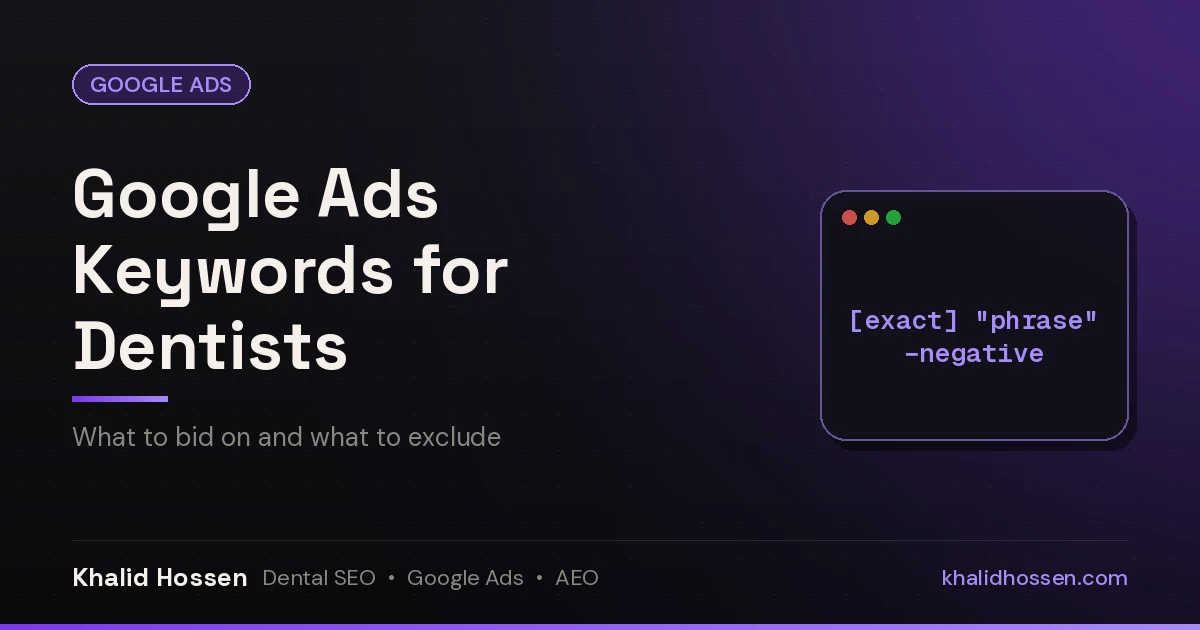
Google has three keyword match types, and its own Help page, About keyword matching options, describes them like this:
- Broad match (no symbols): ads may show on searches related to your keyword, including ones that don't contain its words. It's the default. Google says it's critical to use Smart Bidding with broad match.
- Phrase match ("quotes"): ads may show on searches that include the meaning of your keyword, including more specific versions of it.
- Exact match ([brackets]): ads may show on searches with the same meaning or intent as the keyword. Google says it gives you the most control over who sees your ad and reaches the fewest searches.
Note that even exact match is based on meaning, not on the exact words. So "[emergency dentist]" can match a search such as "dentist for emergencies".
Should dentists use broad, phrase or exact match?
For most practices, I start with phrase and exact match. A dental campaign usually serves a small area and a short list of treatments, and broad match can drift into searches about dental school, dental jobs or home remedies. Phrase and exact match make the search terms report easier to read while you learn what patients actually type.
Broad match can work once the account has steady conversion tracking for calls and booked appointments and runs Smart Bidding, which is how Google recommends using it. Test it in one ad group and check the search terms it brings in before widening it.
What negative keywords should dentists add?
Negative keywords stop your ads from showing on searches you don't want. Here's a starter list for a general or cosmetic practice. Check each one against what you actually offer before adding it:
- Jobs and careers: jobs, hiring, career, salary, resume, internship, dental assistant jobs
- School and training: school, course, degree, program, exam, schools near me, CE
- DIY and home care: diy, at home, home remedy, kit, how to make
- Free or low-cost care: free, charity, dental school clinic. Leave these off if your practice takes part in a community care program.
- Research and images: pictures, images, diagram, wiki, definition
- Things you don't do: dentures, pediatric or sleep apnea, for example, if you refer those patients out
- Other businesses: supply, equipment, software, lab, wholesale
Two rules from Google's About negative keywords page matter here. Negative keywords don't match close variants, so add both the singular and the plural ("job" and "jobs") and common synonyms yourself. And each negative match type behaves differently: a negative broad keyword blocks a search that contains all its words in any order, negative phrase blocks searches with the words in the same order, and negative exact blocks only that search with no extra words.
Google also warns that too many negatives can stop your ads from reaching the right patients. Don't add "cheap" or "cost" by reflex. Plenty of people who search "implant cost" are serious about treatment.
How do you find new negative keywords?
Use the search terms report. It shows the actual searches that triggered your ads. Read it weekly while a campaign is new, then every two weeks. Each time, add irrelevant terms as negatives, and add good terms you haven't covered as new phrase or exact keywords.
Keep a shared negative keyword list for terms that apply everywhere, such as jobs and school. Then add treatment-specific negatives inside each campaign.
How many keywords should a dental campaign have?
There's no required number. A tight ad group usually has a handful of close keywords that share one landing page, such as five to 15 ways of saying "dental implants near me". If one ad can't fit every keyword in the group, split the group. A long list of loosely related keywords makes the ads less relevant and the reports harder to read.
What happens after the click?
The best keyword list still loses patients if nobody answers the phone. Track calls from ads and the website as conversions, and make sure missed calls get a reply. For practices I run Google Ads for, my missed-call text-back is available now for Google Ads clients, by request. It sends a missed caller a quick text so they don't move on to the next ad. Here's how missed-call text-back works.
Want help with it?
If you'd rather have it set up for you, my Google Ads management for dental practices covers keyword research, negative lists, conversion tracking and weekly search-term reviews.
To see what your current account is doing first, get a free AI Search + Google Ads Visibility Audit. You'll get your audit within 3 business days.
Get a free audit · Book a 30-minute strategy call
Related guides
FAQ
What are the best Google Ads keywords for a dental practice?
Treatment and urgency searches with a location or booking signal, such as dental implants in your city, emergency dentist, Invisalign dentist near me and dentist accepting new patients. The right list depends on the treatments you want more of and the area you serve.
Should I bid on my own practice name?
Usually, yes. Brand keywords help you show up when patients search for you by name, including when another practice bids on your name. Keep them in their own campaign so you can report on them separately from new-patient searches.
What is a negative keyword in Google Ads?
A negative keyword stops your ad from showing on searches that contain it. Dentists commonly exclude job, school, DIY and supply searches. Google says negative keywords don't match close variants, so add plurals and synonyms yourself.
Is broad match bad for dentists?
Not always. Google recommends broad match with Smart Bidding, and it can work once calls and booked appointments are tracked as conversions. Many practices start with phrase and exact match for control, then test broad match in one ad group.
How many keywords should a dental campaign have?
There's no set number. Keep each ad group to a small set of close keywords that share one ad and one landing page, and split the group when one ad can't speak to all of them.
How often should I check my search terms report?
Weekly while a campaign is new, then every two weeks once it's steady. Each time, add irrelevant searches as negative keywords and add useful ones you haven't covered as new keywords.
Khalid Hossen has worked in SEO and Google Ads for 14+ years, with 150+ dental & local service businesses served, and helped scale two dental practices to $5M. No long-term contracts. Get a free audit of how your practice shows up in Google, Google Maps and AI answers.